Product Teams of the AI Age Are Being Invented in Real Time
This year, I had the opportunity to lead design on two very different 0-to-1 products at Adobe. Both taught me a lot.
June 3, 2026
Cross-posted from the original published piece: Product Teams of the AI Age Are Being Invented in Real Time.
This year, I had the opportunity to lead design on two very different 0-to-1 products at Adobe. Both taught me a lot. And both challenged some assumptions I had about what product development looks like in the age of AI. One was a race against time. The other was an exercise in patience.
Everyone in the industry is talking about how the traditional roles are blurring. Designers, engineers, product managers. The boundaries are shifting and nobody quite agrees on what the new shape should look like. What I didn't expect was how viscerally I'd experience that firsthand across these two projects, or how much it would sharpen my own sense of where I belong in it.
1. Adobe Firefly Creative Production
Adobe Firefly Creative Production is a node and graph-based workflow automation tool for creating content at scale using Firefly Services and APIs. In many ways, the process looked familiar. We started with research, worked to understand customer pain points, designed, built, tested, learned, and pivoted as our understanding evolved and as the industry changed around us. The unusual part was the compressed timeline. Going from concept to GA in under six months required an extraordinary level of trust, late-night architectural pivots, and constant debates between quality and speed.
At the time, it felt impossibly compressed. Looking back now, it almost feels slow. That's probably the strangest realization I've had over the last year. What felt ambitious twelve months ago now feels like the baseline, and there is a part of me that believes we still haven't found our fastest gear.
There is a real disconnect in the industry right now. On one side, you hear stories about products being built in days, AI agents working through complex tasks for hours, entire companies rethinking how software gets made. On the other side, anyone actually building products understands the reality is more nuanced. There are quality concerns, infrastructure constraints, rate limits, GPU costs, and operational realities that don't disappear just because AI can generate code. One of the unexpected benefits of this project was gaining a much deeper appreciation for those challenges. I developed real empathy for the engineering teams building and maintaining the services our product depended on. The complexity is often invisible until you're the one trying to ship against it.
At the same time, I still find myself asking why it takes us so long to build things. Not from a place of criticism, but from a place of genuine curiosity. If the tools are improving this quickly, shouldn't our ability to execute improve alongside them?
One of my proudest moments on the project came toward the end. For years, design organizations have talked about owning quality. This project gave us the opportunity to take that idea further than I had experienced before. My team was given access to the codebase, and instead of stopping at designs and reviews, we rolled up our sleeves and started contributing directly. We worked alongside engineering to improve quality across the product, took greater ownership of our React component library and Storybook implementation, and expanded our skill sets in ways that helped elevate the teams around us. What started as a conversation about design quality became a conversation about shared ownership. And honestly, I think that's where modern product teams need to head.
2. Adobe Brand Intelligence
Adobe Brand Intelligence, launched at Adobe Summit 2026, is an AI-powered system designed to help organizations understand and operationalize their brand at scale. At its core, it transforms something traditionally subjective into something that can be reasoned about computationally. The challenge is that brands are complicated. Part of a brand lives in tangible assets: layouts, typography, color systems, imagery, voice, and tone. Another part exists entirely in perception, and perception is constantly changing.
The foundation of this product was built by an incredibly talented group of machine learning scientists and engineers who spent months working closely with customers, understanding creative workflows, exploring datasets, and tackling the difficult problem of helping machines develop a deeper understanding of brands. What made this project especially interesting for me was design's role in it. For much of the early journey, there wasn't a traditional product experience to design. The product was essentially a brain. The hardest problems lived inside the models.
As a design leader, that was uncomfortable at first. I spend a lot of time encouraging designers to engage early, help frame problems, and influence outcomes before solutions start taking shape. Here was a project where the center of gravity lived somewhere different. When we eventually joined more deeply, our first job wasn't designing interfaces. It was understanding how the AI worked. Only then could we begin designing the bridge between the technology and the customer use cases it was meant to serve.
The most interesting question isn't whether design belongs in these conversations. It's how much earlier and how much deeper it can go. I don't think our industry has a definitive answer yet, but I'm increasingly convinced that the people best positioned to lead AI products are the ones who can hold both the human experience and the technical system in mind at the same time.
Designing the Operating Model
These two launches could not have been more different. One was product-led and execution-heavy. The other was research-led and model-heavy. One challenged our ability to move faster. The other challenged our understanding of where design fits. Yet both left me optimistic, not because everything went perfectly, but quite the opposite. The most valuable lessons came from the awkward handoffs, the responsibilities that weren't clearly defined, the moments where existing processes struggled to keep up with new technology. Those moments revealed opportunities.
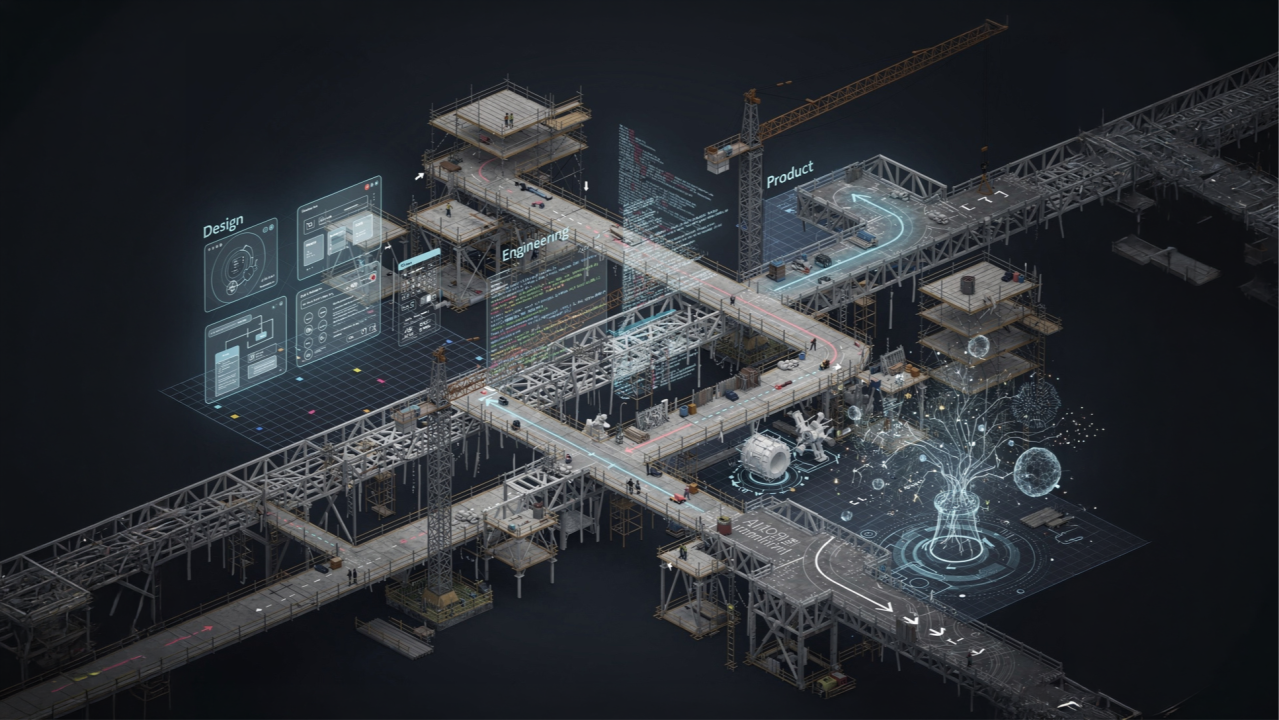
The teams that will thrive over the next few years won't simply adopt AI. They'll rethink how people work together, blur traditional boundaries between design, engineering, product, and research, and create new operating models instead of optimizing old ones.
I am proud of what our teams shipped this year. But the more personal realization has been about where I want to go next. Across both projects, I kept finding myself drawn into questions that sit at the intersection of product strategy, AI systems, and human experience. Not design questions exactly. Not product questions exactly. Something that lives between the two, and that I think increasingly needs to be held by someone who can move fluidly across design, engineering, and data. That's the space where I do my best work, and exactly the kind of team I want to build.